Quality and testing
Tested by batch, graded at the bench.
Test data is only useful if it belongs to the stone in the crate. Every export batch is sampled, tested against BS EN methods and shipped with its own certificate rather than a generic range sheet.
Test regime
Methods and frequency
- Compressive strength
- Per batch
- Flexural strength
- Per batch
- Water absorption
- Per batch
- Apparent density and porosity
- Quarterly
- Abrasion resistance
- Quarterly
- Slip resistance, per finish
- Quarterly
- Frost resistance
- Annually
- Petrographic description
- Annually
- Dimensional tolerance
- Per crate, 5 percent sample
BS EN 1926
BS EN 12372
BS EN 13755
BS EN 1936
BS EN 14157
BS 7976-2 pendulum
BS EN 12371, 48 cycles
BS EN 12407
BS EN 1341 and 1469
Testing is carried out by an independent laboratory in Hyderabad accredited to ISO/IEC 17025, report series MSPI-EX. Certificates are issued in the name of the export batch and emailed with the bill of lading.
Grading
Two tonal bands, labelled by crate.
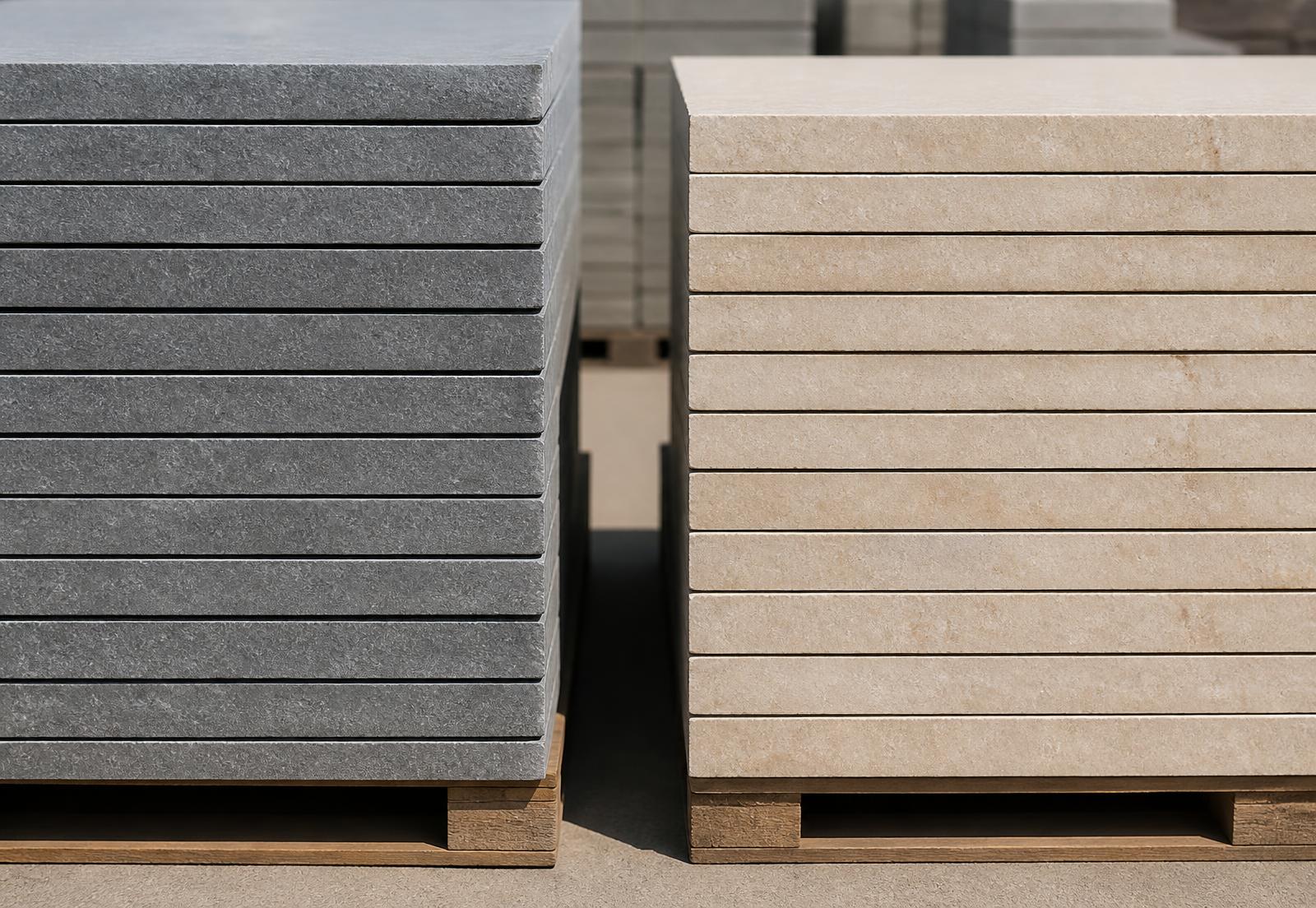
Natural stone from a live bed carries a working tonal range. We grade to two bands per colour and mark the band on the crate, so a contractor can blend from three crates rather than discover the range on the fourth.
Pieces with through-cracks, open seams wider than 0.4 mm, edge chipping over 2 mm or corner loss are rejected at the bench and never crated.
Tolerances and policy
What we hold ourselves to
- Thickness, calibrated finishes
- ±1 mm
- Thickness, riven
- ±3 mm
- Length and width
- ±1 mm
- Squareness
- ±1 mm on the diagonal
- Flatness, 600 mm
- ±0.8 mm
- Breakage credit
- Against photographs, no return required
- Retained reference samples
- Two years per batch
- Order traceability
- Crate number to block run
Certificates for the current batches are available on request.